Dr Manette Is the Reason That Charles Is Released but Is Also the Reason That He Is Comdemned Again
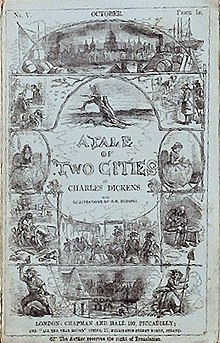 Comprehend of serial Vol. V, 1859 | |
| Author | Charles Dickens |
|---|---|
| Illustrator | Hablot Knight Browne (Phiz) |
| Encompass creative person | Hablot Knight Browne (Phiz) |
| State | Britain |
| Language | English |
| Genre | Historical novel |
| Gear up in | London and Paris, 1775–93 |
| Published | Weekly serial April – November 1859 Book 1859[i] |
| Publisher | London: Chapman & Hall |
| Dewey Decimal | 823.viii |
| LC Grade | PR4571 .A1 |
| Preceded by | Little Dorrit |
| Followed by | Great Expectations |
| Text | A Tale of 2 Cities at Wikisource |
A Tale of Two Cities is an 1859 historical novel by Charles Dickens, gear up in London and Paris before and during the French Revolution. The novel tells the story of the French Physician Manette, his 18-year-long imprisonment in the Bastille in Paris, and his release to live in London with his girl Lucie whom he had never met. The story is set up against the conditions that led up to the French Revolution and the Reign of Terror. In the Introduction to the Encyclopedia of Adventure Fiction, critic Don D'Ammassa argues that it is an hazard novel because the protagonists are in constant danger of being imprisoned or killed.[2]
Every bit Dickens'due south best-known piece of work of historical fiction, A Tale of Two Cities is claimed to exist ane of the all-time-selling novels of all fourth dimension.[three] [iv] [five] In 2003, the novel was ranked 63rd on the BBC's The Big Read poll.[6] The novel has been adapted for film, television, radio, and the stage, and has continued to influence pop culture.
Synopsis [edit]
Book the First: Recalled to Life [edit]
Opening lines [edit]
Dickens opens the novel with a sentence that has become famous:
It was the best of times, it was the worst of times, information technology was the age of wisdom, it was the historic period of foolishness, it was the epoch of belief, it was the epoch of incredulity, it was the season of Light, information technology was the season of Darkness, it was the spring of hope, it was the wintertime of despair, we had everything earlier us, we had nothing earlier usa, we were all going direct to Heaven, we were all going direct the other mode—in curt, the catamenia was and so far like the nowadays period, that some of its noisiest authorities insisted on its being received, for good or for evil, in the superlative degree of comparison only.[7]
Plot of the first book [edit]
In 1775, a human being flags down the nightly mail-coach en road from London to Dover. The man is Jerry Cruncher, an employee of Tellson'south Banking concern in London; he carries a message for Jarvis Lorry, one of the bank'due south managers. Lorry sends Jerry dorsum with the cryptic response "Recalled to Life", referring to Alexandre Manette, a French doctor who has been released from the Bastille after an eighteen-year imprisonment. On arrival in Dover, Lorry meets Dr Manette's daughter Lucie and her governess, Miss Pross. Believing her father to be dead, Lucie faints at the news that he is live. Lorry takes her to France for a reunion.
In the Paris neighbourhood of the Faubourg Saint-Antoine, Dr Manette has been given lodgings by his former servant Ernest Defarge and his wife Therese, the owners of a vino store. Lorry and Lucie find him in a small garret where he spends much of his fourth dimension distractedly and obsessively making shoes – a skill he learned in prison house. Lorry and Lucie have him back to England.
Book the Second: The Gilded Thread [edit]
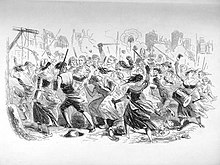
"The Sea Still Rises", an analogy for Book 2, Chapter 22 by "Phiz"
Plot of the second book [edit]
In 1780, French émigré Charles Darnay is on trial in London for treason against the British Crown. The key witnesses confronting him are ii British spies, John Barsad and Roger Cly. Barsad claims that he would recognise Darnay anywhere, but Darnay'due south lawyer points out that his colleague in court, Sydney Carton, bears a potent resemblance to the prisoner. With Barsad'south testimony thus undermined, Darnay is acquitted.
In Paris, the hated and calumniating Marquis St. Evrémonde orders his railroad vehicle driven recklessly fast through the crowded streets, striking and killing a child. The Marquis throws a coin to the child's begetter, Gaspard, to compensate him for his loss; as the Marquis drives on, a money is flung back into the carriage.
Arriving at his country château, the Marquis meets his nephew and heir, Darnay. Out of disgust with his aristocratic family, the nephew has shed his real surname (St. Evrémonde) and anglicised his mother'due south maiden name, D'Aulnais, to Darnay. He despises the Marquis' views that "Repression is the merely lasting philosophy. The dark deference of fear and slavery ... will proceed the dogs obedient to the whip, as long every bit this roof [looking up to information technology] shuts out the sky."[eight] That night, Gaspard creeps into the château and stabs and kills the Marquis in his sleep. He avoids capture for virtually a yr, but is eventually hanged in the nearby village.
In London, Carton confesses his love to Lucie, but quickly recognises that she cannot honey him in render. Carton nonetheless promises to "comprehend any sacrifice for you lot and for those dear to you lot".[ix] Darnay asks for Dr Manette's permission to wed Lucie, and he agrees. On the morning time of the spousal relationship, Darnay reveals his real proper name and lineage to Dr Manette, facts that Manette had asked him to withhold until that twenty-four hour period. The unexpected revelation causes Dr Manette to revert to his obsessive shoemaking. He returns to sanity before their render from honeymoon, and the whole incident is kept secret from Lucie.
Every bit the years pass, Lucie and Charles heighten a family unit in England: a son (who dies in childhood) and a girl, little Lucie. Lorry finds a 2d home with them. Carton, though he seldom visits, is accepted as a close friend and becomes a special favourite of piddling Lucie.
In Paris in July 1789, the Defarges assist to lead the storming of the Guardhouse, a symbol of royal tyranny. Defarge enters Dr Manette'due south former jail cell, One Hundred and V, Due north Tower, and searches it thoroughly. Throughout the countryside, local officials and other representatives of the aristocracy are slaughtered, and the St. Evrémonde château is burned to the ground.
In 1792, Lorry travels to France to salvage important documents stored at Tellson'southward Paris co-operative from the chaos of the French Revolution. Darnay receives a letter of the alphabet from Gabelle, one of his uncle's old servants who has been imprisoned by the revolutionaries, pleading for the Marquis to help secure his release. Without telling his family or revealing his position as the new Marquis, Darnay also sets out for Paris.
Volume the Third: The Runway of a Tempest [edit]
Plot of the 3rd book [edit]
Soon later on Darnay's arrival in Paris, he is denounced as an illegal emigrated aristocrat and jailed in La Force Prison. Hoping to be able to save him, Dr Manette, Lucie and her daughter, Jerry, and Miss Pross all move to Paris and take up lodgings near those of Lorry.
15 months later Darnay is finally tried, and Dr Manette – viewed equally a popular hero later his long imprisonment in the Bastille – testifies on his behalf. Darnay is acquitted and released, but is re-arrested afterwards that mean solar day.
While running errands with Jerry, Miss Pross is amazed to run into her long-lost brother Solomon. Now posing as a Frenchman, he is an employee of the revolutionary authorities and one of Darnay'southward gaolers. Carton also recognises him – equally Barsad, one of the spies who tried to frame Darnay at his trial in 1780. Solomon is desperate to keep his truthful identity hidden, and past threatening to denounce him as an English spy Carton blackmails Solomon into helping with a plan.
Darnay'southward retrial the following 24-hour interval is based on new denunciations by the Defarges, and on a manuscript that Defarge had establish when searching Dr Manette's prison cell. Defarge reads the manuscript to the tribunal. In it, Dr Manette had recorded that his imprisonment was at the hands of the Evrémonde brothers (Darnay's father and uncle) after he had tried to report their crimes. Darnay's uncle had kidnapped and raped a peasant girl. Her brother, first hiding his remaining younger sis, had gone to face up the uncle, who ran him through with his sword. In spite of the all-time efforts of Dr Manette, both the elderberry sis and the brother died. Dr Manette's manuscript concludes by denouncing the Evrémondes, "them and their descendants, to the last of their race."[10] The jury takes that every bit irrefutable proof of Darnay's guilt, and he is condemned to die by the guillotine the adjacent afternoon.
In the Defarges' vino store, Carton discovers that Madame Defarge was the surviving sister of the peasant family, and he overhears her planning to denounce both Lucie and her daughter. He visits Lorry and warns him that Lucie and her family must be ready to abscond the next solar day. He extracts a promise that Lorry and the family volition exist waiting for him in the carriage at ii pm, ready to exit the very instant he returns.
Presently before the executions are due to begin, Carton puts his plan into effect and, with Barsad'due south reluctant assist, obtains access to Darnay's prison house cell. Carton intends to be executed in Darnay's identify. He drugs Darnay and trades clothes with him, then has Barsad carry Darnay out to the carriage where Lorry and the family unit are expecting Carton. They flee to England with Darnay, who gradually regains consciousness during the journeying.
Meanwhile, Madame Defarge goes to Lucie's lodgings, hoping to apprehend her and her daughter. There she finds Miss Pross, who is waiting for Jerry so they tin can follow the family unit out of Paris. The two women struggle and Madame Defarge's pistol discharges, killing her outright and permanently deafening Miss Pross.

The seamstress and Carton, an illustration for Book 3, Chapter 15 by John McLenan (1859)
As Carton waits to board the tumbril that will take him to his execution, he is approached past another prisoner, a seamstress. Carton comforts her, telling her that their ends will be quick and that the worries of their lives will not follow them into "the better land where ... [they] will be mercifully sheltered." A terminal prophetic thought runs through his mind in which he visualises a better future for the family and their descendants.
Closing lines [edit]
Dickens closes with Carton's final prophetic vision as he contemplates the guillotine:[eleven]
I see Barsad, and Cly, Defarge, The Vengeance [a lieutenant of Madame Defarge], the Juryman, the Judge, long ranks of the new oppressors who have risen on the destruction of the erstwhile, perishing by this retributive musical instrument, before it shall cease out of its nowadays utilise. I see a beautiful city and a vivid people rising from this completeness, and, in their struggles to exist truly gratis, in their triumphs and defeats, through long years to come, I see the evil of this fourth dimension and of the previous fourth dimension of which this is the natural nascence, gradually making expiation for itself and wearing out.
I see the lives for which I lay downward my life, peaceful, useful, prosperous and happy, in that England which I shall run across no more. I meet Her with a child upon her bosom, who bears my name. I see her father, aged and bent, merely otherwise restored, and faithful to all men in his healing function, and at peace. I come across the skillful onetime man [Lorry], so long their friend, in ten years' time enriching them with all he has, and passing tranquilly to his reward.
I see that I concord a sanctuary in their hearts, and in the hearts of their descendants, generations hence. I see her, an former woman, weeping for me on the anniversary of this 24-hour interval. I encounter her and her husband, their course done, lying side by side in their last earthly bed, and I know that each was not more honoured and held sacred in the other's soul than I was in the souls of both.
I see that child who lay upon her bosom and who bore my name, a man winning his style up in that path of life which one time was mine. I see him winning it and then well, that my proper name is made illustrious there by the light of his. I see the blots I threw upon it, faded away. I see him, fore-virtually of just judges and honoured men, bringing a boy of my proper noun, with a forehead that I know and golden pilus, to this place—and so fair to look upon, with not a trace of this day's disfigurement—and I hear him tell the child my story, with a tender and a faltering voice.
It is a far, far ameliorate thing that I exercise, than I accept ever done; it is a far, far better rest that I go to than I have always known.
Characters [edit]
In order of appearance:
Book the First (Nov 1775) [edit]
Chapter two
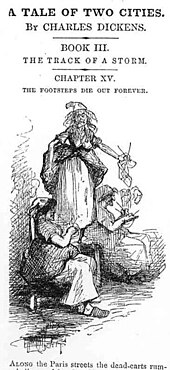
Illustration from a serialised edition of the story, showing three tricoteuses knitting, with the Vengeance continuing in the heart.
- Jerry Cruncher: Porter and messenger for Tellson's Bank and secret "Resurrection Human" (torso-snatcher); though crude and abusive towards his married woman, he provides mettlesome service to the Manettes in Book the Third. His first proper noun is brusque for Jeremiah; the latter name shares a meaning with the name of Jarvis Lorry.
- Jarvis Lorry: A director at Tellson's Bank: "...a admirer of 60 ... Very orderly and methodical he looked ... He had a practiced leg, and was a little vain of it..." He is a honey friend of Dr Manette and serves as a sort of trustee and guardian of the Manette family. The banking concern places him in accuse of the Paris branch during the Revolution, putting him in position to provide life-saving service to the Manettes in Book the Third. The end of the book reveals that he lives to be 88.
Chapter 4
- Lucie Manette: Daughter of Dr Manette; an platonic pre-Victorian lady, perfect in every way. About 17 when the novel begins, she is described equally short and slight with a "pretty figure, a quantity of golden hair, a pair of blue optics..." Although Sydney Carton is in dear with her, he declares himself an unsuitable candidate for her mitt in marriage and instead she marries Charles Darnay, with whom she is very much in love, and bears him a daughter. Nevertheless, Lucie genuinely cares about Carton's welfare and defends him when he is criticised past others. She is the "gilt thread" afterward whom Volume the Second is named, and then called considering she holds her father's and her family'due south lives together (and because of her blonde hair like her female parent's). She as well ties almost every character in the book together.[12]
Chapter 5
- Monsieur Defarge: Given name Ernest, he is the possessor of a Paris wine store and leader of the Jacquerie. "A bull-necked, martial-looking homo of 30 ... He was a nighttime man altogether, with practiced eyes and a good bold breadth between them." He is devoted to Dr Manette having been his retainer as a youth. One of the key Revolutionary leaders, in which he is known as Jacques Four, he embraces the Revolution equally a noble cause, unlike many other revolutionaries. Though he truly believes in the principles of the Revolution, Defarge is far more moderate than some of the other participants (notably his married woman).
- Madame Defarge: Given name Thérèse; a vengeful female Revolutionary, she is arguably the novel'southward adversary and is presented every bit a more farthermost and bloodthirsty personality than her hubby Ernest. "There were many women at that fourth dimension, upon whom the time laid a dreadfully disfiguring hand; but, at that place was not one among them more to be dreaded than this ruthless woman ... Of a stiff and fearless character, of shrewd sense and readiness, of smashing decision, of that kind of beauty which not only seems to impart to its possessor firmness and antagonism, but to strike into others an instinctive recognition of those qualities." The source of her implacable hatred of the Evrémonde family is revealed tardily in the novel to be the rape of her sister and killing of her blood brother when she was a kid.
- Jacques One, Two, and 3: Revolutionary compatriots of Ernest Defarge. Jacques Three is peculiarly bloodthirsty and serves as a juryman on the Revolutionary Tribunals.
Affiliate 6
- Dr Alexandre Manette: Lucie'due south father; when the book opens, he has just been released later on a ghastly 18 years as a prisoner in the Bastille. Weak, agape of sudden noises, barely able to behave on a conversation, he is taken in by his true-blue former servant Defarge who and then turns him over to Jarvis Lorry and the girl he has never met. He achieves recovery and contentment with her, her eventual husband Charles Darnay, and their niggling girl. All his happiness is put at take a chance in Book the Third when Madame Defarge resolves to ship Evrémonde/Darnay to the guillotine, regardless of his having renounced the Evrémondes' wealth and cruelty. At the same time, the reader learns the cause of Dr Manette's imprisonment: he had rendered medical intendance to Madame Defarge's blood brother and sister following the injuries inflicted on them by the Evrémonde twins back in 1757; the Evrémondes decided he couldn't be allowed to expose them.
Book the Second (5 years later) [edit]
Chapter 1
- Mrs Cruncher: Wife of Jerry Cruncher. She is a very religious woman, but her husband, somewhat paranoid, claims she is praying (what he calls "flopping") against him, and that is why he does not often succeed at piece of work. Jerry ofttimes verbally and, almost equally frequently, physically abuses her, merely at the end of the story, he appears to feel somewhat guilty about this.
- Immature Jerry Cruncher: Son of Jerry and Mrs Cruncher. Young Jerry frequently follows his male parent effectually to his father's odd jobs, and at i betoken in the story, follows his father at night and discovers that his father is a Resurrection Man. Young Jerry looks up to his father as a role model and aspires to become a Resurrection Homo himself when he grows up.
Chapter two
- Charles Darnay: A Frenchman of the noble Evrémonde family; "...a young man of about five-and-twenty, well-grown and well-looking, with a sunburnt cheek and a dark eye." When introduced, he is on trial for his life at the Old Bailey on charges of spying on behalf of the French crown. In disgust at the cruelty of his family unit to the French peasantry, he took on the name "Darnay" (later his mother'south maiden name, D'Aulnais) and left French republic for England.[xiii] He and Lucie Manette fall deeply in beloved, they marry, and she gives nascence to a daughter. He exhibits an admirable honesty in his decision to reveal to Dr Manette his truthful identity every bit a fellow member of the infamous Evrémonde family. He puts his family unit's happiness at risk with his mettlesome determination to return to Paris to save the imprisoned Gabelle, who, unbeknownst to him, has been coerced into luring him at that place. Once in Paris, he is stunned to notice that, regardless of his rejection of his family unit's exploitative and abusive tape, he is imprisoned incommunicado simply for beingness an blueblood. Released afterward the testimony of Dr Manette, he is re-arrested and sentenced to exist guillotined owing to Madame Defarge's undying hatred of all Evrémondes. This death judgement provides the pretext for the novel's climax.
Affiliate 3
- John Barsad (real name Solomon Pross): An informer in London and subsequently employed by the Marquis St. Evrémonde. When introduced at Charles Darnay's trial, he is giving damning evidence against the defendant but information technology becomes clear to the reader that he is an oily, untrustworthy graphic symbol. Moving to Paris he takes service equally a police spy in the Saint Antoine district, under the French monarchy. Post-obit the Revolution, he becomes an agent for Revolutionary France (at which point he must hide his British identity). Although a man of depression character, his position as a spy allows him to arrange for Sydney Carton's final heroic act (after Carton blackmails him with revealing his duplicity).
- Roger Cly: Barsad's collaborator in spying and giving questionable testimony. Post-obit his chaotic funeral procession in Volume the 2d, Chapter 14, his coffin is dug up past Jerry Cruncher and his boyfriend Resurrection Men. In Book the Third, Jerry Cruncher reveals that in fact the casket independent only rocks and that Cly was clearly still alive and no doubt conveying on his spying activities.
- Mr Stryver: An ambitious barrister, senior partner to Sydney Carton.[14] "... a man of petty more than thirty, just looking 20 years older than he was, stout, loud, red, barefaced, and free from any drawback of delicacy..."; he wants to marry Lucie Manette because he believes that she is attractive enough. However, he is non truly in beloved with her and in fact treats her condescendingly. Jarvis Lorry suggests that marrying Lucie would be unwise and Stryver, afterwards thinking information technology over, talks himself out of it, after marrying a rich widow instead.
- Sydney Carton: A quick-minded and highly intelligent simply depressed English barrister, referred to by Dickens as "The Jackal" because of his deference to Stryver. When introduced, he is a hard-drinking cynic, having watched Stryver advance while never taking advantage of his ain considerable gifts: Dickens writes that the sunday rose "upon no sadder sight than the man of skillful abilities and practiced emotions, incapable of their directed exercise, incapable of his own help and his own happiness, sensible to the bane on him, and resigning himself to permit it eat him away." In beloved with Lucie Manette, she cares about him but more every bit a concerned mother figure than a potential mate. He ultimately becomes a selfless hero, redeeming everything by sacrificing his life for a worthy cause.
Chapter six
- Miss Pross: Lucie Manette'due south governess since Lucie was x years old: "... one of those unselfish creatures—found only among women—who will, for pure love and admiration, bind themselves willing slaves, to youth when they take lost it, to beauty that they never had..." She is fiercely loyal to Lucie and to England. She believes her long-lost brother Solomon, now the spy and perjurer John Barsad, is "the one human worthy of Ladybird," ignoring the fact that he "was a heartless scoundrel who had stripped her of everything she possessed, as a stake to speculate with, and had abased her in her poverty for evermore..." She is not agape to physically fight those she believes are endangering the people she loves. She permanently loses her hearing when the fatal pistol shot goes off during her climactic fight with Madame Defarge.
Chapter seven
It took four men, all four a-bonfire with gorgeous decoration, and the Master of them unable to be with fewer than 2 gilded watches in his pocket, emulative of the noble and chaste fashion set by Monseigneur, to conduct the happy chocolate to Monseigneur'south lips.
It was incommunicable for Monseigneur to dispense with 1 of these attendants on the chocolate and concur his high place under the admiring Heavens. Deep would have been the blot upon his escutcheon if his chocolate had been ignobly waited on by only three men; he must have died of 2.
And who amid the visitor at Monseigneur'due south reception in that seventeen hundred and eightieth yr of our Lord, could possibly uncertainty, that a system rooted in a frizzled hangman, powdered, gold-laced, pumped, and white-silk stockinged, would see the very stars out!
- "Monseigneur": An unnamed generic aristocrat whose extraordinary decadence and self-assimilation, described in detail, are used by Dickens to characterise the ancien régime in full general. "The leprosy of unreality disfigured every homo creature in attendance upon Monseigneur." His fellow nobles also luxuriate in vast wealth, merely this does non inoculate them from feeling envy and resentment: equally the Marquis St. Evrémonde leaves Monseigneur's house "with his lid under his arm and his snuff-box in his manus", he turns to the latter's bedroom and quietly says, "I devote you ... to the Devil!" When the Revolution begins, Monseigneur puts on his cook's clothing and ignominiously flees, escaping with only his life.
- Marquis St. Evrémonde:[fifteen] Uncle of Charles Darnay: "...a man of well-nigh lx, amply dressed, haughty in fashion, and with a confront like a fine mask." Adamant to preserve the traditional prerogatives of the nobility until the finish of his life, he is the twin brother of Charles Darnay's belatedly father; both men were exceptionally arrogant and cruel to peasants. Lamenting reforms which accept imposed some restraints on the abusive powers of his form, the Marquis is out of favour at the royal court at the fourth dimension of his assassination. Murdered in his bed by the peasant Gaspard.
- Gaspard: A peasant whose child is run over and killed by the Marquis St. Evrémonde'south carriage. He plunges a knife into Evrémonde's heart, pinning a note that reads, "Drive him fast to his tomb," a reference to the devil-may-care speed that caused his little kid'due south decease. After being in hiding for a year, he is institute, arrested, and executed.
- The Mender of Roads: A peasant who later works every bit a woodsawyer; the Defarges bring him into a conspiracy against the aristocracy, where he is referred to as Jacques Five.
Chapter viii
- Théophile Gabelle: Gabelle is "the Postmaster, and some other taxing functionary, united"[16] for the tenants of the Marquis St. Evrémonde. Gabelle is imprisoned by the revolutionaries, and his beseeching letter brings Darnay to France. Gabelle is "named after the hated salt tax".[17]
Book the Third (Fall 1792) [edit]
Chapter 3
- The Vengeance: A companion of Madame Defarge referred to as her "shadow" and lieutenant, a fellow member of the sisterhood of women revolutionaries in Saint Antoine, and Revolutionary zealot. (Many Frenchmen and women did change their names to show their enthusiasm for the Revolution.[eighteen]) Carton predicts that the Vengeance, Defarge, Cly, and Barsad volition exist consumed by the Revolution and end up on the guillotine.
Chapter xiii
- The Seamstress: "...a young woman, with a slight girlish grade, a sweet spare face up in which there was no vestige of colour, and big widely opened patient eyes..." Having been defenseless upwards in The Terror, she strikes up a conversation with the human she assumes is Evrémonde in the large room where the next day'southward guillotine victims are gathered. When she realises that some other man has taken Charles Darnay'due south identify, she admires his sacrifice and asks if she tin can hold his paw during their tumbril ride to the place of execution.
Sources [edit]
While performing in The Frozen Deep, Dickens was given a play to read chosen The Dead Heart by Watts Phillips which had the historical setting, the bones storyline, and the climax that Dickens used in A Tale of Two Cities.[19] The play was produced while A Tale of Two Cities was being serialised in All the Year Round and led to talk of plagiarism.[xx]
Other sources are The French Revolution: A History past Thomas Carlyle (especially important for the novel'due south rhetoric and symbolism);[21] Zanoni by Edward Bulwer-Lytton; The Castle Spector by Matthew Lewis; Travels in France by Arthur Immature; and Tableau de Paris by Louis-Sébastien Mercier. Dickens also used material from an account of imprisonment during the Terror by Beaumarchais, and records of the trial of a French spy published in The Almanac Register.[22]
Research published in The Dickensian in 1963 suggests that the house at i Greek Street, now The House of St Barnabas, forms the ground for Dr Manette and Lucie's London firm.[23]
In a building at the back, accessible by a courtyard where a plane tree rustled its green leaves, church organs claimed to be made, and likewise gold to be beaten by some mysterious behemothic who had a golden arm starting out of the wall ... as if he had browbeaten himself precious.[24]
The "gold arm" (an arm-and-hammer symbol, an ancient sign of the gold-beater'due south craft) is now housed at the Charles Dickens Museum, but a modern replica could be seen sticking out of the wall nigh the Pillars of Hercules pub at the western end of Manette Street (formerly Rose Street),[25] until this building was demolished in 2017.
Publication history [edit]
The 45-chapter novel was published in 31 weekly instalments in Dickens's new literary periodical titled All the Year Circular. From Apr 1859 to November 1859, Dickens also republished the capacity as eight monthly sections in light-green covers. All but iii of Dickens's previous novels had appeared equally monthly instalments prior to publication as books. The first weekly instalment of A Tale of Two Cities ran in the beginning event of All the Yr Round on thirty Apr 1859. The final ran 30 weeks later, on 26 November.[1]
The Telegraph and The Guardian claim that it is one of the all-time-selling novels of all time.[3] [4] [26] WorldCat listed 1,529 editions of the work, including 1,305 print editions.[27]
Analysis [edit]
A Tale of Two Cities is one of only two works of historical fiction past Charles Dickens (the other existence Barnaby Rudge).[28]
Dickens uses literal translations of French idioms for characters who cannot speak English, such every bit "What the devil exercise you practice in that galley at that place?!!" and "Where is my wife? … Here you lot see me."[29] The Penguin Classics edition of the novel notes that "Not all readers take regarded the experiment as a success."[29]
J. Fifty. Borges quipped: "Dickens lived in London. In his book A Tale of Two Cities, based on the French Revolution, we see that he really could not write a tale of two cities. He was a resident of only one city: London."[30]
Autobiographical material [edit]
Some have argued that in A Tale of Two Cities Dickens reflects on his recently begun affair with xviii-year-old actress Ellen Ternan, which was possibly platonic but certainly romantic. Lucie Manette has been noted equally resembling Ternan physically.[31]
After starring in a play by Wilkie Collins titled The Frozen Deep, Dickens was first inspired to write Two Cities. In the play, Dickens played the part of a human being who sacrifices his own life and then that his rival may take the woman they both beloved; the love triangle in the play became the basis for the relationships amongst Charles Darnay, Lucie Manette, and Sydney Carton in Two Cities.[32]
Sydney Carton and Charles Darnay may bear chiefly on Dickens's personal life. The plot hinges on the near-perfect resemblance between Sydney Carton and Charles Darnay; the two look so akin that Carton twice saves Darnay through the inability of others to tell them autonomously. Carton is Darnay made bad. Carton suggests as much:
'Do yous particularly like the man [Darnay]?' he muttered, at his own paradigm [which he is regarding in a mirror]; 'why should you particularly similar a man who resembles you? At that place is nothing in you lot to like; yous know that. Ah, confound yous! What a modify you have made in yourself! A good reason for talking to a man, that he shows yous what you have fallen away from and what you might take been! Change places with him, and would you have been looked at past those blueish optics [belonging to Lucie Manette] as he was, and commiserated by that agitated face as he was? Come on, and have it out in apparently words! You detest the fellow.'[33]
Many take felt that Carton and Darnay are doppelgängers, which Eric Rabkin defines as a pair "of characters that together, represent ane psychological persona in the narrative".[34] If so, they would prefigure such works equally Robert Louis Stevenson's Dr Jekyll and Mr Hyde. Darnay is worthy and respectable just dull (at least to near modern readers), Carton disreputable but magnetic.[ citation needed ]
One can only doubtable whose psychological persona information technology is that Carton and Darnay together embody (if they practice), merely it is often thought to be the psyche of Dickens. He might accept been quite aware that between them, Carton and Darnay shared his ain initials, a frequent property of his characters.[35] However, he denied it when asked.
Dickens defended the book to the Whig and Liberal prime minister Lord John Russell: "In remembrance of many public services and individual kindnesses."[36]
Gimmicky criticisms [edit]
The reports published in the press were divergent. Thomas Carlyle was enthusiastic, which made the author "heartily delighted".[37] On the other mitt, Mrs. Oliphant establish "little of Dickens" in the novel.[38] The critic James Fitzjames Stephen called information technology a "dish of puppy pie and stewed cat which is not disguised by the cooking" and "a disjointed framework for the brandish of the tawdry wares, which are Mr Dickens's stock-in-trade.[39]
Adaptations [edit]

Films [edit]
- A Tale of 2 Cities, a 1911 silent movie.
- A Tale of Ii Cities, a 1917 silent movie.
- A Tale of Two Cities, a 1922 silent film.
- The Only Way, a 1927 silent British moving picture directed by Herbert Wilcox.
- A Tale of 2 Cities, a 1935 black-and-white picture starring Ronald Colman, Elizabeth Allan, Reginald Owen, Basil Rathbone, and Edna May Oliver, nominated for the Academy Award for Best Movie.
- A Tale of Two Cities, a 1958 version, starring Dirk Bogarde, Dorothy Tutin, Christopher Lee, Leo McKern, and Donald Pleasence.
- A Tale of Two Cities, a 1980 version, starring Chris Sarandon, Alice Krige and Kenneth More.
Radio [edit]
- Beginning on 8 Apr 1935, WCAE in Pittsburgh, Pennsylvania, presented A Tale of Two Cities "in chapter sequence" on Mon nights.[xl]
- On 25 July 1938, The Mercury Theatre on the Air produced a radio adaptation starring Orson Welles. Welles also starred in a version broadcast on Lux Radio Theater on 26 March 1945.
- Ronald Colman recreated his 1935 motion-picture show office three times on radio: twice on the Lux Radio Theatre, first on 12 January 1942 with Edna Best and over again on 18 March 1946 with Heather Angel, and in one case on the 9 March 1948 broadcast of Favorite Story (director Cecil B. DeMille's "favorite story").
- On vii October 1943, a portion of the novel was adapted to the syndicated programme The Weird Circle as "Dr Manette's Manuscript."
- In 1950, the BBC circulate a radio adaptation by Terence Rattigan and John Gielgud of their unproduced 1935 stage play.
- A half-hr version titled "Sydney Carton" was broadcast on 27 March 1954 on Theatre Royal hosted past and starring Laurence Olivier.
- In June 1989, BBC Radio four produced a 7-hour drama adjusted for radio past Nick McCarty and directed by Ian Cotterell. This accommodation has been occasionally repeated by BBC Radio seven and afterward BBC Radio 4 Actress (well-nigh recently in 2009). The cast included Charles Dance as Sydney Carton, Maurice Denham as Dr Manette, Richard Pasco every bit Mr Lorry, John Moffatt as Marquis St. Evrémonde, Charlotte Attenborough as Lucie Manette, John Duttine every bit Darnay, Aubrey Forest as Mr Stryver and Barbara Leigh-Chase as Miss Pross.
- In December 2011, every bit office of its special flavour on Charles Dickens'south Bicentenerary,[41] BBC Radio 4 produced a new 5-office accommodation for radio by Mike Walker with original music by Lennert Busch and directed by Jessica Dromgoole and Jeremy Mortimer[42] which won the 2012 Bronze Sony Radio Academy Award for Best Drama.[43] The cast included Robert Lindsay equally the voice of Charles Dickens, Paul Ready as Sydney Carton, Karl Johnson equally Dr Manette, Lydia Wilson as Lucie Manette, Jonathan Coy as Mr Lorry, Andrew Scott every bit Darnay, Alison Steadman as Miss Pross and Clive Merrison as Marquis St. Evrémonde.
- In 2018, A Tale of Ii Cities: Aleppo and London, a three-part adaptation of the Dickens novel written by Ayeesha Menon and directed by Polly Thomas was broadcast on BBC Radio 4, updating the story and characters to set it in modern-day London and state of war-torn Syria.[44] The cast included Shaun Parker equally Sid (Sydney Carton), Lara Sawalha every bit Lina (Lucie Manette), Fatima Adoum as Taghreed (Madame Defarge), Phil Davis as Jarvis (Mr Lorry), Khalid Abdalla as Shwan Dahkurdi (Charles Darnay) and Nadim Sawalha as Dr Mahmoud (Dr Manette).
Tv [edit]
- ABC produced a 2-part mini-serial in 1953.[45]
- The BBC produced an eight-part mini-series in 1957 starring Peter Wyngarde as Sydney Carton, Edward de Souza as Charles Darnay and Wendy Hutchinson as Lucie Manette.
- The BBC produced a ten-function mini-series in 1965 starring John Wood as Carton, Nicholas Pennell as Charles Darnay, Kika Markham as Lucie Manette and Patrick Troughton equally Dr Manette.[46]
- The BBC produced some other eight-part mini-series in 1980 starring Paul Shelley equally Carton/Darnay, Sally Osborne as Lucie Manette and Nigel Stock as Jarvis Lorry.
- A Tale of Two Cities, a 1984 Boob tube animated version by Burbank Animation Studios.[47]
- ITV Granada produced a two-part mini-series in 1989 starting James Wilby every bit Sydney Carton, Xavier Deluc equally Charles Darnay and Serena Gordon as Lucie Manette. The production likewise aired on Masterpiece Theatre on PBS in the United States.[48] [49]
Stage productions [edit]
- Royal & Derngate Theatre produced an accommodation by Mike Poulton with original music by Rachel Portman, directed by James Dacre.
- The Regent's Park Open up Air Theatre staged an adaptation by Matthew Dunster in 2017, directed by creative manager Timothy Sheader.
Phase musicals [edit]
Phase musical adaptations of the novel include:
- 2 Cities, the Spectacular New Musical (1968), with music by Jeff Wayne, lyrics by Jerry Wayne and starring Edward Woodward.[50]
- A Tale of Ii Cities (1998), with music by David Pomeranz and book past Steven David Horwich and David Soames. The musical was deputed past Paul Nicholas and co-produced by Nib Kenwright ran at the New Alexandra Theatre in Birmingham during their 1998 Christmas flavour with Paul Nicholas as Sydney Carton.
- Ii Cities (2006), a musical by Howard Goodall, which was set during the Russian Revolution, with the two cities being London and St. Petersburg.
- A Tale of Two Cities, a musical by Jill Santoriello, which opened on Broadway at the Al Hirschfeld Theatre on 18 September 2008. The production starred James Barbour equally Sydney Carton, Natalie Toro equally Madame Defarge and Brandi Burkhardt every bit Lucie Manette. The show was directed and choreographed by Warren Carlyle. Since Broadway, the show has been performed in the Us, Canada, United Kingdom, Germany, Japan and Korea.[51]
Opera [edit]
- Arthur Benjamin's operatic version of the novel, subtitled Romantic Melodrama in Half dozen Scenes, premiered on 17 April 1953, conducted by the composer. Information technology received its stage premiere at Sadler's Wells on 22 July 1957, nether the billy of Leon Lovett.[52]
Books [edit]
- Dav Pilkey wrote a comic titled Dog Man: A Tale of Two Kitties, loosely based on the novel.
Popular culture [edit]
At the 1984 Autonomous National Convention in the U.s., the keynote speaker, Mario Cuomo of New York, delivered a scathing criticism of and so-President Ronald Reagan's comparing of the United States to a "shining city on a colina" with an allusion to Dickens'south novel, saying: "Mr President, you lot ought to know that this nation is more a Tale of 2 Cities than information technology is just a 'Shining City on a Hill'."[53] [54]
A Tale of Ii Cities served as an inspiration to the 2012 Batman moving picture The Dark Knight Rises by Christopher Nolan. The character of Bane is in role inspired past Dickens's Madame Defarge: He organises kangaroo court trials against the ruling aristocracy of the urban center of Gotham and is seen knitting in one of the trial scenes like Madame Defarge. At that place are other hints to Dickens'due south novel, such as Talia al Ghul being obsessed with revenge and having a close human relationship to the hero, and Blight's catchphrase "the fire rises" every bit an ode to 1 of the book's chapters.[55] Bane'due south associate Barsard is named later a supporting grapheme in the novel. In the film's terminal scene, Jim Gordon (Gary Oldman) reads aloud the closing lines of Sydney Carton'southward inner monologue—"It'due south a far far better thing I practice than I have ever washed, it'southward a far far better residual I go to than I accept e'er known"—direct from the novel.[56]
References [edit]
- ^ a b "Facsimile of the original 1st publication of "A Tale of Ii Cities" in All the year round". S4ulanguages.com. Retrieved 5 January 2013.
- ^ Done D'Ammassa, Encyclopedia of Adventure Fiction. Facts on File Library of Globe Literature, Infobase Publishing, 2009. pp. seven–8.
- ^ a b "Charles Dickens novel inscribed to George Eliot upwards for sale". The Guardian . Retrieved 7 September 2019.
- ^ a b "A Tale of Two Cities, King's Head, review". The Telegraph. Archived from the original on 11 January 2022. Retrieved seven September 2019.
- ^ "TLSWikipedia all-conquering – The TLS". 26 May 2016. Archived from the original on 26 May 2016. Retrieved 17 February 2021.
- ^ "The Big Read". BBC. Apr 2003. Retrieved 26 July 2019
- ^ Charles Dickens, A Tale of Two Cities, Book the Showtime, Chapter I.
- ^ Dickens 2003, p. 128 (Book 2, Chapter 9). This statement[ commendation needed ] (nearly the roof) is truer than the Marquis knows, and another example of foreshadowing: the Evrémonde château is burned downwardly by revolting peasants in Book ii, Affiliate 23.
- ^ Dickens 2003, p. 159 (Book 2, Affiliate xiv)
- ^ Dickens 2003, p. 344 (Volume iii, Chapter x)
- ^ Dickens 2003, p. 390 (Book 3, Chapter xv)
- ^ Dickens 2003, p. 83 (Volume 2, Affiliate 4)
- ^ After Dr Manette'south letter is read, Darnay says that "It was the always-vain endeavour to discharge my poor mother'southward trust, that beginning brought my fatal presence well-nigh you." (Dickens 2003, p. 347 [Book 3, Affiliate xi].) Darnay seems to be referring to the time when his female parent brought him, even so a child, to her meeting with Dr Manette in Book 3, Chapter x. But some readers as well feel that Darnay is explaining why he changed his name and travelled to England in the first place: to discharge his family'due south debt to Dr Manette without fully revealing his identity. (See annotation to the Penguin Classics edition: Dickens 2003, p. 486.)
- ^ Stryver, like Carton, is a barrister and non a solicitor; Dickens 2003, p. xi
- ^ Also chosen "The Younger", having inherited the title at "the Elder"'s expiry, the Marquis is sometimes referred to every bit "Monseigneur the Marquis St. Evrémonde". He is not so chosen in this article because the title "Monseigneur" applies to whoever among a group is of the highest status; thus, this title sometimes applies to the Marquis and other times does not.
- ^ Dickens 2003, p. 120 (Book two, Chapter viii)
- ^ Dickens 2003, p. 462
- ^ Dickens 2003, p. 470
- ^ Dickens by Peter Ackroyd; Harper Collins, 1990, p. 777
- ^ Dickens past Peter Ackroyd; Harper Collins, 1990, p. 859
- ^ Dickens, Charles (1970) [1859]. Woodcock, George (ed.). A tale of Two Cities. Illust. by Hablot L. Browne. Penguin Books. pp. 408, 410; due north. thirty, 41. ISBN0140430547.
- ^ Dickens by Peter Ackroyd; Harper Collins, 1990, pp. 858–862
- ^ Chesters & Hampshire, Graeme & David (2013). London'south Clandestine Places. Bath, England: Survival Books. pp. 22–23.
- ^ A Tale of Two Cities, Charles Dickens
- ^ Richard Jones. Walking Dickensian London. New Kingdom of the netherlands Publishers, 2004. ISBN 9781843304838. p. 88.
- ^ Thonemann, Peter (25 May 2016). "The all-conquering Wikipedia?". the-tls.co.united kingdom of great britain and northern ireland . Retrieved 29 May 2016.
This figure of 200 million is – to state the obvious – pure fiction. Its ultimate source is unknown: perhaps a hyperbolic 2005 press release for a Broadway musical adaptation of Dickens' novel. But the presence of this canard on Wikipedia had, and continues to have, a startling influence. Since 2008, the claim has been recycled repeatedly…
- ^ http://world wide web.worldcat.org/search?q=ti%3AA+Tale+of+2+Cities+au%3ACharles+Dickens&dblist=638&fq=ap%3A%22dickens%2C+charles%22&qt=facet_ap%3A
- ^ "world wide web.dickensfellowship.org, 'Dickens every bit a Fiction Writer'". Retrieved 1 January 2015.
- ^ a b Dickens, Charles (2003). A Tale of 2 Cities (Revised ed.). London: Penguin Books Ltd. pp. 31, 55. ISBN978-0-141-43960-0.
- ^ Borges, Jorge Luis (31 July 2013). Professor Borges: A Grade on English Literature . New Directions Publishing. p. 159 – via Net Archive.
- ^ Dickens 2003, p. xxi
- ^ "Context of A Tale of Two Cities". Retrieved iii August 2009.
- ^ Dickens 2003, p. 89 (Book 2, Chapter four) p. 89
- ^ Rabkin 2007, course booklet p. 48
- ^ Schlicke 2008, p. 53
- ^ Dickens, Charles (1866), A Tale of Two Cities (Start ed.), London: Chapman and Hall, p. iii, retrieved 6 July 2019
- ^ Charles Dickens, Letters, "Letter to Thomas Carlyle, 30 Oct 1859.
- ^ Margaret Oliphant," Review of A Tale of 2 Cities, Blackwood'due south, No. 109, 1871.
- ^ James Fitzjames Stephen, Saturday Review, 17 December 1859.
- ^ Hamilton, Jane (viii April 1935). "Dickens Radio Revival Tale of 2 Cities WCAE Presentation". Pittsburgh Sunday-Telegraph. p. xvi. Retrieved 9 May 2022 – via Newspapers.com.
- ^ "Dickens on Radio 4".
- ^ Dromgoole, Jessica. "A Tale of Two Cities on BBC Radio 4. And a podcast besides!".
- ^ "Sony Radio University Award Winners". The Guardian. 15 May 2012. Retrieved 12 March 2014.
- ^ "A Tale of Two Cities: Aleppo and London". BBC. Retrieved 30 Apr 2020
- ^ chasmilt777 (10 August 2006). ""The Plymouth Playhouse" A Tale of Two Cities: Part 1 (Telly Episode 1953)". IMDb.
- ^ "A Tale of Two Cities: Episode 1". eleven April 1965. p. 17 – via BBC Genome.
- ^ IMDb
- ^ New York Magazine, 23 Sep 1991, p. 176, at Google Books
- ^ Jack Goldstein and Isabella Reese 101 Amazing Facts well-nigh Charles Dickens, p. 11, at Google Books
- ^ The Encyclopedia of the Musical Theatre, Volume ane. Schirmer Books. 1994. p. 358.
- ^ BWW News Desk. "A Tale of Two Cities Adds Two Performances at Birdland". BroadwayWorld.com . Retrieved 23 December 2018.
- ^ "A Tale of 2 Cities (1949–fifty)". Boosey & Hawkes . Retrieved 12 March 2014.
- ^ Duffy, Bernard 1000.; Leeman, Richard Due west. (2005). American Voices: An Encyclopedia of Gimmicky Orators. Greenwood Publishing Grouping. p. 100. ISBN9780313327902.
- ^ Shesol, Jeff (ii Jan 2015). "Mario Cuomo's Finest Moment". The New Yorker. ISSN 0028-792X. Retrieved 6 May 2018.
- ^ "Christopher Nolan on The Dark Knight Rises ' Literary Inspiration". ComingSoon.net. eight July 2012. Retrieved 29 December 2017.
- ^ "The Dark Knight Rises". Sydney Morning Herald . Retrieved 30 April 2020.
Works cited [edit]
- A Tale of 2 Cities Shmoop: Study Guides & Teacher Resources. Web. 12 March 2014.
- Biedermann, Hans. Lexicon of Symbolism. New York: Superlative (1994) ISBN 978-0-452-01118-2
- Dickens, Charles. A Tale of Two Cities. Edited and with an introduction and notes by Richard Maxwell. London: Penguin Classics (2003) ISBN 978-0-14-143960-0
- Drabble, Margaret, ed. The Oxford Companion to English Literature. fifth ed. Oxford, United kingdom: Oxford University Press (1985) ISBN 0-19-866130-iv
- Forster, E. Chiliad. Aspects of the Novel (1927). 2005 reprint: London: Penguin. ISBN 978-0-14-144169-6
- Orwell, George. "Charles Dickens". In A Collection of Essays. New York: Harcourt Brace Jovanovich (1946) ISBN 0-15-618600-4
- Rabkin, Eric. Masterpieces of the Imaginative Mind: Literature's Most Fantastic Works. Chantilly, VA: The Education Company (2007)
- Schlicke, Paul. Coffee With Dickens. London: Duncan Baird Publishers (2008) ISBN 978-i-84483-608-6
- A Tale of 2 Cities: Graphic symbol Listing SparkNotes: Today'due south Near Popular Written report Guides. Web. 11 April 2011.
- Ackroyd, Peter. Dickens. London: HarperCollins (1990). ISBN 0-06-016602-9.
Further reading [edit]
- Alleyn, Susanne. The Annotated A Tale of Ii Cities. Albany, New York: Spyderwort Press (2014) ISBN 978-1535397438
- Glancy, Ruth. Charles Dickens' A Tale of Two Cities: A Sourcebook. London: Routledge (2006) ISBN 978-0-415-28760-9
- Sanders, Andrew. The Companion to A Tale of Two Cities. London: Unwin Hyman (1989) ISBN 978-0-04-800050-seven Out of print.
External links [edit]
- A Tale of Two Cities read online at Bookwise
- A Tale of Two Cities at Standard Ebooks
- A Tale of Two Cities at Internet Archive.
- A Tale of Ii Cities at Projection Gutenberg
- A Tale of Two Cities – The original manuscript of the novel, held past the Victoria and Albert Museum (requires Adobe Wink).
- 'Dickens: A Tale of 2 Cities', lecture by Dr. Tony Williams on the writing of the volume, at Gresham College on 3 July 2007 (with video and audio files available for download, too as the transcript).
- A Tale of Two Cities summary, Charles Dickens
-
 A Tale of Ii Cities public domain audiobook at LibriVox
 - Analysis of A Tale of Two Cities on Lit React
Source: https://en.wikipedia.org/wiki/A_Tale_of_Two_Cities
0 Response to "Dr Manette Is the Reason That Charles Is Released but Is Also the Reason That He Is Comdemned Again"
Post a Comment